The Numbers
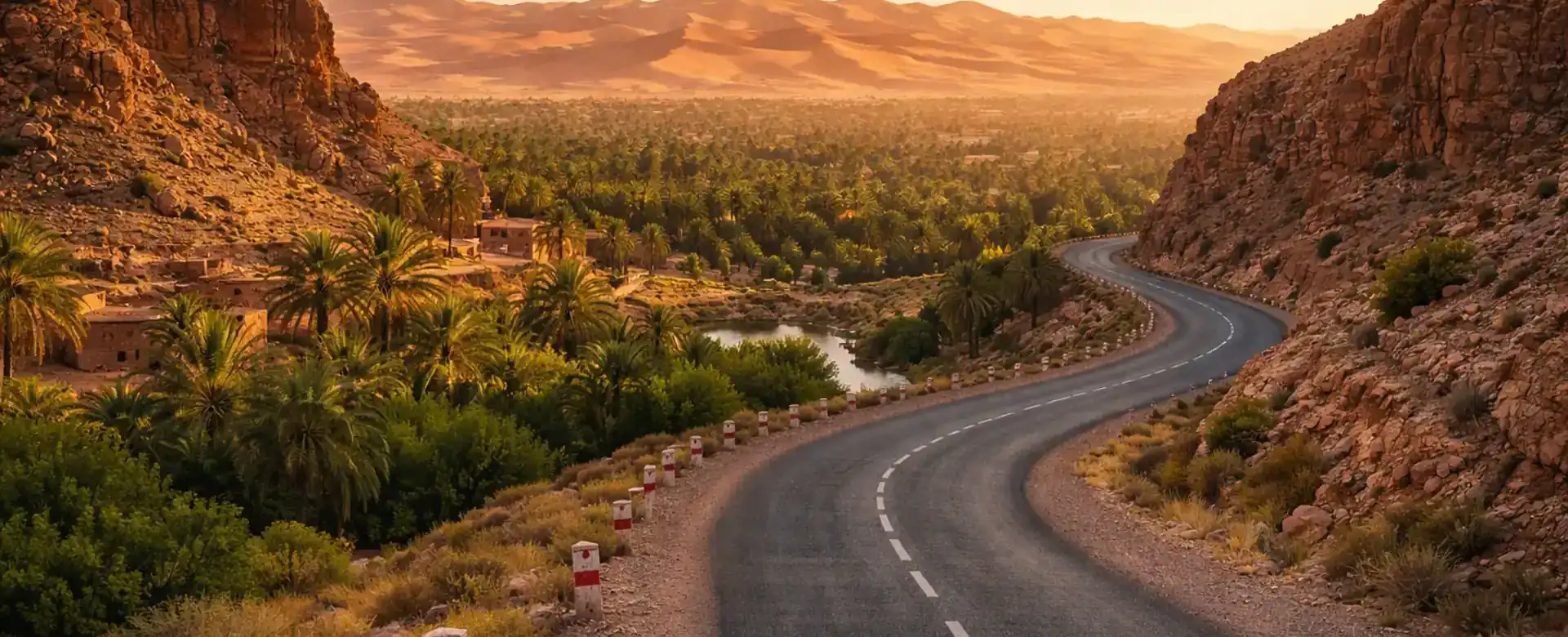
Marrakech to Merzouga is 560 kilometres by the standard route through Ouarzazate. Driving time without stops is around 7 hours. With the stops that make the journey worthwhile — Ait Benhaddou, a lunch break, the Draa Valley — you are looking at 9 to 10 hours door to door.
This is why a 2-day trip to Merzouga does not work. You spend 9 hours driving on Day 1, arrive at the dunes at 6pm for the camel ride, and then spend another 9 hours driving on Day 3. The desert itself — the actual reason you came — gets about 14 hours. The 3-day tour adds one full day in Merzouga. The 4-day version distributes the driving more sensibly.
The Route Explained
There are two routes from Marrakech to Merzouga. Almost everyone takes the southern route through Ouarzazate — the one that goes over the Atlas Mountains. The northern route through Midelt and Er Rachidia is faster in pure distance but less scenic and misses all the major stops. Unless you are in a hurry on the return, always go south.
Marrakech → Tizi n'Tichka (2,260m)
The first two hours of the drive are the Atlas Mountains. The road climbs steadily out of Marrakech, switching back and forth up the mountain face until it reaches the Tizi n'Tichka pass at 2,260 metres — the highest paved mountain pass in Morocco. In winter the pass can be covered in snow. In spring the slopes are green and the air smells of thyme. It is almost always cold up there, regardless of what the temperature was in Marrakech.
Tizi n'Tichka → Ouarzazate (1 hour)
The descent from the pass opens onto the southern plateau — suddenly warmer, drier, the vegetation sparser. The landscape changes completely within 30 minutes of crossing the summit. Ait Benhaddou sits just before Ouarzazate, 32 kilometres from the top of the pass.
Ouarzazate → Skoura → Boumalne Dades (2 hours)
The road follows the Draa Valley eastward. Skoura is worth a brief stop — the palmery here is one of the most beautiful in Morocco, with ancient kasbahs half- hidden in the date palms. Boumalne Dades is where most tours stop for the night on the 4-day version. The Dades Gorges are 25 kilometres north of the town.
Boumalne Dades → Tinghir → Merzouga (3 hours)
The road continues east through increasingly sparse landscapes. Tinghir is the gateway to the Todra Gorges — a 300-metre slot canyon that takes 45 minutes to walk through and costs nothing to enter. Past Tinghir the terrain becomes flat and almost lunar — the Tafilalet plains. The first sign that you are approaching the desert is the sudden appearance of date palm oases and then, on the horizon, what looks like a low orange cloud that does not move. That is Erg Chebbi.
Key Stops Along the Way
Ait Benhaddou
A UNESCO World Heritage Site and the most photographed kasbah in Morocco. Used as a film location in Gladiator, Game of Thrones, Lawrence of Arabia, The Mummy and about 20 other productions. Plan for one hour minimum. Entrance is around 50 MAD per person. A local guide at the gate costs 50 to 100 MAD and is worth it — without context, it is just a pile of impressive mud bricks.
Ouarzazate
Lunch stop. The town itself is not particularly interesting but it has good restaurants and the Atlas Film Studios — the largest film studio complex outside Hollywood — if anyone in your group is interested. The studios tour takes about an hour and costs around 60 MAD.
Todra Gorges
Optional but highly recommended if you are doing the 4-day tour. The gorges are 30 kilometres north of Tinghir on a good paved road. Park at the entrance, walk 20 minutes through the canyon, turn around. The walls are 300 metres high and close enough that you could almost touch both sides. Swimming in the river at the base is possible in summer.
Driving Tips & Road Conditions
The route is entirely on paved roads until the last few kilometres into Merzouga village, which is a dirt track. No 4x4 required to reach Merzouga itself — a regular car handles it fine. The Tizi n'Tichka pass can be slow in summer (tourist season traffic) and occasionally closed for a few hours in winter due to snow.
If you are driving yourself, fuel up in Ouarzazate — there are limited stations east of there. The road between Tinghir and Merzouga has almost no services for about 200 kilometres.
If you are on a guided tour, none of this is your problem. Your driver knows the route, the stops and where to eat. The whole point of a guided tour on this particular route is that the logistics are invisible to you.
Marrakech to Merzouga vs Alternatives
Zagora is 370 km from Marrakech — about 6 hours. Smaller dunes but the same camp experience. The right choice if you only have 2 days.
Erg Chegaga near M'Hamid is similar in distance to Merzouga but requires a 4x4 crossing from M'Hamid. The dunes are larger and completely empty. The Ouarzazate 2-day tour is the natural stopover on the way south. Requires 5 days minimum.
Agafay Desert is 40 minutes from Marrakech. Rocky plateau, not sandy dunes, but it has camel rides and dinner camps and works perfectly for a half-day or evening experience if you do not have time for the Sahara.