The Falls — What You're Actually Looking At
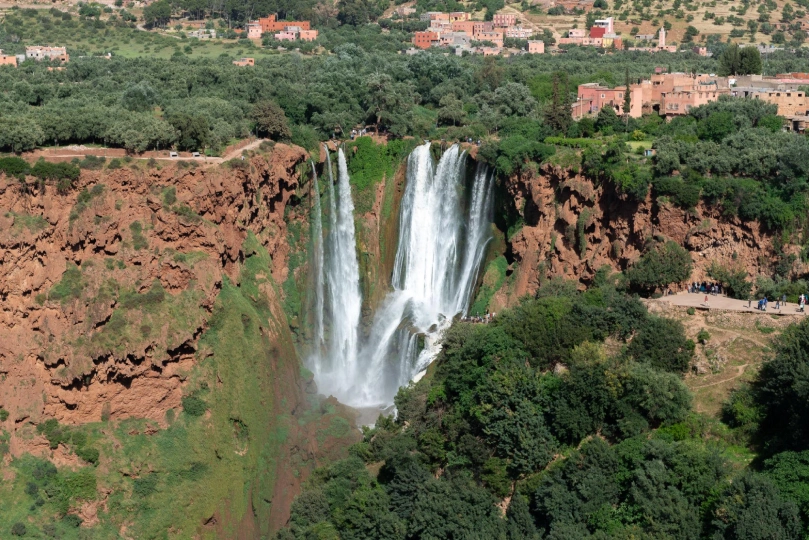
Ouzoud sits on the Oued el-Abid river in the foothills of the Middle Atlas, about 150 kilometres northeast of Marrakech. The name means "the act of grinding" in Tamazight — the old olive mills that used the river's power still stand at the top of the falls.
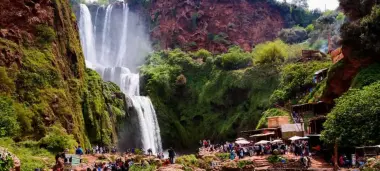
The main cascade drops 110 metres in three distinct tiers before reaching the gorge at the base. At full flow — usually March through May — the volume of water is enough to produce a permanent rainbow in the mist on sunny mornings. The pool at the base is surrounded by wild olive, oleander and argan trees.
The falls are fed by the reservoir of Bin el Ouidane dam upstream, which means the flow varies less than most natural waterfalls — there is always water at Ouzoud. What changes seasonally is volume and colour. After winter rains the water runs orange-brown from the clay. In spring it clears. By August the flow drops noticeably but the falls never stop.
Best Time to Visit
March to May is the best window. The flow is at maximum, the surrounding vegetation is green, temperatures at the base are comfortable (18 to 24°C) and the light on the water in the morning is exceptional. This is also peak season — arrive before 9am to have the main viewpoints to yourself.
October and November are the second-best option. The summer heat has broken, the crowds thin considerably and the autumn colours in the olive groves above the falls add something the spring visit doesn't have.
Summer (June to August) works but requires planning. The gorge at the base stays cool even when temperatures above are 38°C — the mist and shade create a natural microclimate. Come early, stay at the base during midday, leave before 4pm to avoid the afternoon heat on the road back. Crowds on weekends in July and August are significant — Moroccan families make this a summer outing, which creates a different and genuinely lively atmosphere.
Winter (December to February) is the quietest period. The water level is good, the macaques are more active in cooler temperatures, and the light is low and dramatic. The road from Marrakech is reliable in winter — Ouzoud is below the snowline and the approach is straightforward.
Getting There from Marrakech
Ouzoud is 150 kilometres northeast of Marrakech — about 2.5 hours by road via the N8 through Aït Attab. The route is paved and well-maintained throughout. No 4x4 required at any point. The final approach is a single road into the village above the falls with a large parking area at the top.
The most practical option for most visitors is a guided day trip from Marrakech — the drive is enjoyable but long, and the return adds up to five hours of driving in a day. Having a driver means you can focus on the falls rather than navigation and parking.
Public transport exists but is slow. A CTM bus from Marrakech to Azilal (the nearest town, 20km away) takes around 3.5 hours. From Azilal, a grand taxi covers the remaining distance. Total journey time one way: 4 to 5 hours. Not impossible, but it turns a day trip into something that requires an overnight.
Driving yourself: the N8 out of Marrakech is straightforward. The route is signposted. Fill up in Marrakech or Aït Attab — the village at Ouzoud has a small petrol station but supply is inconsistent. Parking at the top costs 20 MAD.
What to Do at the Base
The standard visit involves walking down the main path from the village — about 20 minutes on a stone-paved trail through olive trees. The path is well-maintained and suitable for most fitness levels, though it is steep in sections. Sandals work but closed shoes are more comfortable on the descent.
At the base, the best spot is the flat rock area directly in front of the lower tier — close enough to feel the mist, far enough to see the full height. The rainbow appears on the left side of the falls between 9am and noon on clear days. Bring a dry bag or waterproof case for your phone.
Boat rides onto the pool are available from local operators at the base — small wooden rowboats that take you directly under the lowest tier of the falls. Cost is around 30 to 50 MAD per person. The experience of sitting in the mist under the cascade is worth it. The boats look precarious and are perfectly safe.
There are paths along both sides of the gorge that lead to viewpoints above the falls. The left-side path (facing the falls) gives you the classic frontal view from above. The right-side path takes you around to a perspective looking down the gorge — less visited and genuinely dramatic. Allow 45 minutes for the full circuit.
Planning a day outside Marrakech? Our guided Ouzoud day trip covers transport, the full visit and lunch at the falls.
See the Ouzoud day trip →The Barbary Macaques
The Barbary macaques at Ouzoud are one of the main draws and consistently the element that surprises visitors most. They live in the cliffs above the falls and have been around tourists for long enough to be entirely unbothered by human presence. A group of them typically occupies the middle section of the main descent path.
They will sit next to you on a rock, climb onto your shoulder if you let them, and take food directly from your hand. The honest advice: keep food in your bag and don't offer it. Not because the macaques are dangerous — they are not — but because feeding them keeps them on the path rather than in the forest, which is not good for the animals long-term. A macaque sitting next to you unprompted is a better experience than one trying to pull a sandwich out of your bag.
There are approximately 300 Barbary macaques in the Ouzoud area. They are listed as endangered — their range in Morocco and Algeria has shrunk significantly over the past 50 years. The Ouzoud population is one of the more stable groups because the forest around the falls is protected and the tourist activity, managed reasonably, does not push them out.
Where to Eat
The terrace restaurants built into the cliff overlooking the falls are one of the better meals you can have on a day trip from Marrakech — not because the food is exceptional (it is standard Moroccan, executed well) but because the setting is absurd. You eat looking directly at the upper tier of the falls from above, with the sound of the water below and the macaques occasionally appearing on the railing.
Prices are tourist-level — expect 80 to 130 MAD for a tagine with bread and mint tea. The quality between the half-dozen cliff restaurants is broadly similar. The ones with the best views fill up by noon in high season — arrive by 12:30pm if you want a terrace table. The restaurants at the top of the village (before the descent) are cheaper and have no view — skip them.
Fresh-squeezed orange juice from the vendors on the main path is 15 MAD and worth it. Bottled water is available throughout but bring your own from Marrakech — it is cheaper and you will drink more than you expect in the heat.
Practical Information
Entry: There is no entrance fee to the falls area. Parking costs 20 MAD at the top of the village. The boat rides and guided path tours are optional and priced separately.
What to bring: Comfortable walking shoes with grip on the descent. A light layer — the base of the gorge is noticeably cooler than the top. Sunscreen for the road and upper section. Cash in dirhams for boats, restaurants and vendors — no card terminals at the falls.
Photography: The light is best on the falls between 9am and noon. Afternoon light hits the cliff wall behind the falls rather than the water itself. For the rainbow, face the falls with the sun behind you on a clear morning.
Crowds: Weekends (Saturday and Sunday) in July and August are the busiest. Moroccan school holidays add volume in late June and early July. A Tuesday or Wednesday in October is the quietest combination. Arriving before 9am on any day gives you 45 minutes before the main groups arrive.
Staying overnight: There are a handful of small guesthouses in the village above the falls for those who want to see the falls at dawn before day trippers arrive. Basic rooms, 200 to 350 MAD per night. Worth considering if you are building your own itinerary rather than doing a day trip.