Before You Start — One Thing to Decide
Three days in Marrakech is the right amount of time. Enough to see the medina properly, do one day trip outside the city, and visit the gardens and the Kasbah quarter without feeling rushed. More than three days and most visitors start running out of medina content.
The one decision that shapes everything else: do you want a guide for the medina, or do you want to navigate it alone?
With a guide, the medina is a completely different experience. You move efficiently, understand what you are looking at, and the persistent vendor approach that exhausts solo visitors simply does not happen — a guided guest with a purpose is left alone. The quality of what you discover goes up significantly.
Without a guide, the medina is an adventure. You will get lost (genuinely — even with Google Maps). You will encounter real hospitality in places tourists rarely reach. You will also encounter some persistent selling. Solo women travelers occasionally encounter something more — the medina has an active social life and unexpected invitations are not uncommon. Whether that sounds appealing or exhausting tells you which option is right for you.
Both are valid. Just decide before Day 1 so you are not making the choice at 9am at the edge of the souks with your phone dying.
Day 1 — Inside the Medina
Morning: 8am — The City Before the Tourists
Arrive at Djemaa el-Fna before 9am. The square at this hour belongs to the city — orange juice vendors setting up their carts (12 to 15 MAD a glass, ask without ice), locals crossing on their way to work, the smell of bread from the bakeries in the surrounding alleys. No snake charmers, no noise. Sit at one of the café terraces on the southern edge and watch Marrakech wake up.
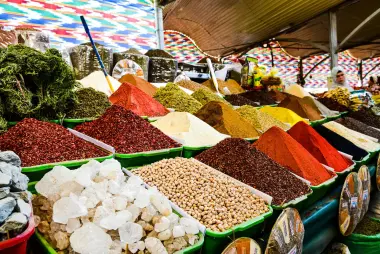
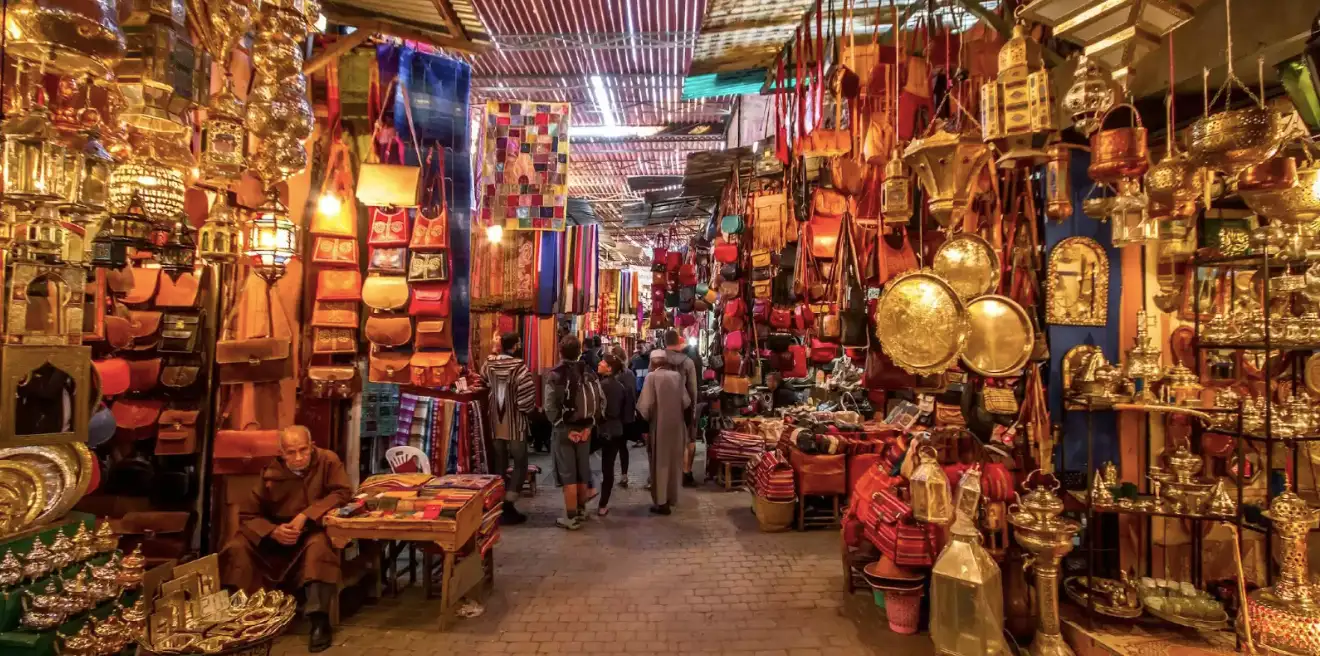
From the square, head north into the souks. Early morning is the best time — the merchants are arranging their displays, the light is good, and the narrow alleyways are not yet full. The spice souk near the Rahba Kedima square is worth spending time in. The mounds of cumin, saffron, dried rose petals and ras el hanout are at their most photogenic before the crowds arrive.
Late Morning: Bahia Palace
Leave the souks by 10:30am and walk south to the Bahia Palace — about 15 minutes on foot. Built in the late 19th century for the vizier Ahmed ibn Moussa, the palace covers 8 hectares of gardens, courtyards and reception rooms. The main reception hall — carved plaster walls, painted cedar ceilings, hand-laid zellige floors — is one of the finest interiors in Morocco. Entrance 70 MAD.
Go on a weekday morning. By 11am on weekends it starts filling up with tour groups. Allow 45 minutes. The garden courtyards are as good as the interiors.
Afternoon: Get Lost in the Kasbah Quarter
South of the Bahia Palace, the Kasbah quarter is the oldest part of the medina — quieter, less touristy, more residential. Walk south from the palace towards Bab Agnaou, one of the original 12th-century city gates. From there the Saadian Tombs (entrance 70 MAD) are a 5-minute walk — the mausoleum of the Saadian dynasty, sealed for centuries and rediscovered in 1917. Small, quiet and genuinely moving.
Spend the rest of the afternoon walking without a destination. The Kasbah alleys produce the best spontaneous encounters in Marrakech — a carpenter's workshop, a woman selling bread from a basket, a group of boys playing football in a square too small for football. This is what most visitors miss by staying on the tourist circuit.
Evening: Djemaa el-Fna from Above
Return to Djemaa el-Fna at sunset — but go up, not into the crowd. The café terraces on the south side of the square (Café de France, Café Glacier, Taj'in Darna) have views over the entire space as the evening market assembles below. The smoke from 300 charcoal grills, the sound of the Gnaoua drums, the minaret of the Koutoubia against the evening sky. Dinner at the square once — for the experience, not for the food. Agree on the price before sitting down anywhere.
Day 2 — Get Out of the City
After a full day in the medina, almost everyone needs a day outside Marrakech — the Ourika Valley day trip is the closest Atlas escape — see the Ourika Valley guide for trails and what to expect. The city is intense. The Atlas is 30 minutes away.
The best Day 2 option depends on what you want:
Ourika Valley — 1 hour south into the High Atlas. River, Berber villages, a waterfall hike, lunch on a terrace over the water. Back in Marrakech by 4pm — the earliest returning day trip. Choose this if you want green landscape, a gentle hike and a quiet afternoon.
Ouzoud Waterfalls — 2.5 hours northwest. 110-metre cascade, Barbary macaques, lunch at the base of the falls. The best single natural site within a day's drive of Marrakech. Choose this if you want something visually dramatic and do not mind a longer drive.
Essaouira — 2.5 hours west on the Atlantic coast. Blue medina, fishing port, the wind, the ramparts at sunset. A completely different Morocco from Marrakech. Choose this if you want a coastal day and a change of pace.
Day 3 — Majorelle, Guéliz and the Last Afternoon
8am — Majorelle Garden (before the crowds)
Majorelle opens at 8am. Be there at 8am, not at 10am. The garden is 1 hectare — small enough that by 10am on most days the paths are too crowded for comfortable photography. At 8am you sometimes have sections to yourself. The cobalt blue buildings against the bamboo and bougainvillea in the morning light are worth the early start. Entrance 150 MAD including the Berber Museum. Allow 90 minutes.
Late Morning — Guéliz
Walk or take a taxi to Guéliz — the new city, built under the French protectorate, about 2 kilometres west of the medina. Wide streets, cafés, galleries, the best supermarkets in Marrakech. The Yves Saint Laurent Museum is here (50 MAD entrance) — a good small museum about the designer's relationship with Marrakech, housed in a building designed for the purpose. Coffee at a Guéliz café terrace is an entirely different experience from the medina — a 20 MAD espresso, a croissant, people cycling to work. The closest Marrakech gets to a European city.
Afternoon — Le Jardin Secret and the Last Hours
Return to the medina for the afternoon. Le Jardin Secret on Rue Mouassine (70 MAD entrance) is worth visiting on your last day rather than your first — you appreciate the architecture more once you have walked the medina for two days. Climb the tower for the rooftop view over the medina, the minarets and the Atlas.
The last hours in the medina are for whatever you missed. The leather tanneries near the Chouara souk (free from the surrounding terrace shops, which will offer you mint to hold against your nose). The brass workers' souk near Bab Debbagh. A last mint tea in a courtyard café. The medina always has something left.
Where to Eat — Real Addresses
For fish — Snack Al Bahri
Al Bahri is one of the most reliably good value eating spots in Marrakech — fresh fish cooked simply, at prices that are honest for what you get. The quality is comparable to the port restaurants in Essaouira, which is the standard by which fish in Marrakech should be judged. No tourist menu, no show — just good fish at fair prices. A proper meal for 60 to 80 MAD.
For modern Moroccan — Fusion Beldi
Fusion Beldi does what the name suggests — traditional Moroccan dishes presented with a contemporary approach. Tagines, couscous, bastilla, all executed carefully in a setting that feels modern without being pretentious. Mid-range prices for Marrakech, genuinely good quality. The kind of place where you can bring someone who has never eaten Moroccan food and guarantee a good experience.
For tanjiya — Chez Bejgueni
Tanjiya is the dish of Marrakech — lamb or beef, marinated in preserved lemon, cumin, saffron and garlic, slow-cooked for hours in a terracotta jarre buried in the hot ashes of the hammam furnace. It is a dish that exists almost nowhere outside Marrakech. Chez Bejgueni is one of the best places to eat it — traditional setting, prices that reflect a local restaurant rather than a tourist one, and a tanjiya that justifies the reputation. Go for lunch.
For mechoui — Chez Lamine
Next to Bejgueni, Chez Lamine specialises in mechoui — whole lamb slow-roasted in a clay oven until the meat falls from the bone. Ordered by weight, eaten with bread, cumin and salt. One of the most straightforward and satisfying meals in Moroccan cuisine. The restaurant is a local institution, not a tourist destination. Budget 80 to 120 MAD per person.
For spicy food lovers — Restaurant Ouazzani
If you like your food with real heat, Restaurant Ouazzani is the address. Authentic Moroccan cuisine that does not tone down the spices for tourists — the dishes are seasoned the way Marrakchis eat them, not the softened version served on the main square. Good for anyone who wants to understand what Moroccan food actually tastes like when it is not adjusted for international palates.
For a cheap meal in Guéliz — Little Mama
Little Mama is the go-to for budget eating in Guéliz — good food, low prices, consistently popular with residents of the new city. If you are spending Day 3 in Guéliz and want lunch without the medina pricing, this is the address.
With or Without a Guide?
We mentioned this at the start because it genuinely changes the experience. A few more specific notes:
A good medina guide costs 200 to 300 MAD for a half-day. For first-time visitors, it is worth every dirham — you will see and understand more in four hours with a guide than in a full day alone. The guides who wait near the main entrances to the souks are unofficial; the better option is to book through your riad or a registered tour operator.
Solo female travelers navigating the medina without a guide should know that attention — sometimes quite direct attention — is part of the experience in some areas, particularly around Djemaa el-Fna in the evenings. It is manageable with confidence and a clear direction of travel. With a guide it does not happen. The choice is a personal one, not a safety question.
For Day 2 outside Marrakech, a driver-guide is the most practical option regardless — public transport to the Atlas and the coast is slow and complicated. A private day trip with an experienced driver is efficient and not expensive.
Practical Notes
Currency: MAD (Moroccan dirham). 1 euro ≈ 10-11 MAD. Cash is essential in the medina — many small shops and restaurants do not accept cards. ATMs are available on the edges of the medina and throughout Guéliz.
Prices to know: Mint tea 15-20 MAD (do not bargain for this — it is a fair price). Fresh juice 12-15 MAD. Coffee 20-25 MAD. Taxi across town 15-25 MAD (insist on the meter). Museum entrance typically 50-70 MAD.
Getting lost: It will happen. It is fine. The medina is about 1.5 km across — you cannot go too far wrong. Ask someone attached to a shop (not a passer-by) for directions. Maps.me works offline and is more reliable than Google Maps in the medina.
Dress code: Not strict but respectful. Shoulders and knees covered in the medina shows basic respect and also reduces unwanted attention. In Guéliz, anything appropriate for a European city is fine.
Best time to visit: March to May and September to November. July and August in Marrakech can reach 40°C — the medina becomes genuinely uncomfortable in the middle of the day.