Arrival at Erg Chebbi
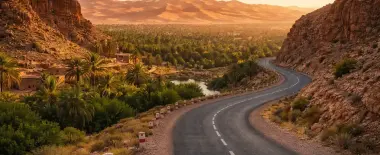
The approach to Merzouga from the north is one of the better moments of our 3-day Sahara tour — desert tour — the road crosses flat hammada (rocky desert) for hours before the dunes suddenly appear on the horizon. The orange of Erg Chebbi against the blue sky of late afternoon is the first confirmation that the 9-hour drive was worth it.
Arrival at the camp edge is usually between 4pm and 5pm, timed to allow the camel ride and arrival at camp before sunset. Your luggage goes ahead by 4x4 — you do not carry anything on the camel. There is time to check into your room at the auberge, leave behind anything you do not need in the dunes, and change before the ride.
The Camel Ride to Camp
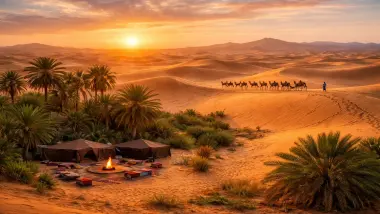
The camel ride from the village edge to the camp takes 45 minutes to an hour depending on how deep into the dunes the camp is positioned. The route goes through the lower dunes first — orange sand, the occasional dried grass tuft — before climbing into the larger dunes as the light changes.
Camels are not comfortable animals. They rock significantly when walking and the saddle is a wooden frame covered with a blanket. One hour is manageable for most people. If anyone in your group has back or knee issues, the 4x4 transfer is always available as an alternative — no one should feel obliged to ride.
The camels are led by a local guide who walks alongside. The pace is slow and the animals are calm. Sunset tends to happen during the ride, which is the best possible timing — the dunes turn from orange to deep red to purple as the light drops, and the shadows become long and dramatic across the sand.
The Berber Camp
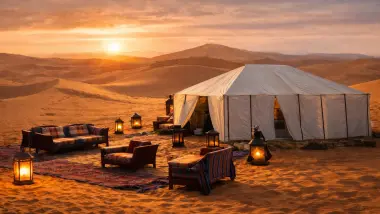
The standard Berber camp at Erg Chebbi consists of a central communal area — a covered dining tent, a fire pit, a small stage area for the evening music — surrounded by individual sleeping tents. The tents are low, with a traditional carpet floor and simple bedding. Basic washing facilities are in a separate area.
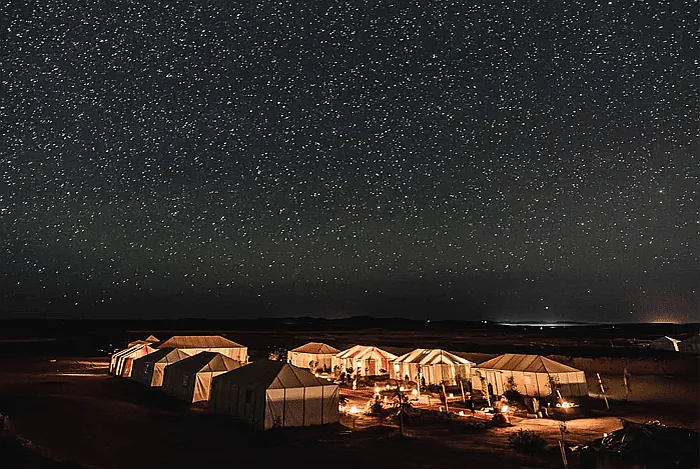
The camp is positioned inside the dunes, out of sight of the road and the village. The visual effect of opening the tent and seeing only sand in every direction is immediate. No buildings, no lights, no road. The nearest artificial light source is Merzouga village, which is invisible over the dune ridge.
Luxury camps are a different proposition — private tents with proper beds, en-suite bathrooms, electricity and sometimes heating. The price difference is significant. Whether it is worth it depends on whether you are there to sleep comfortably or to have a specific experience. The standard camp delivers the experience. The luxury camp delivers comfort.
Evening — Dinner, Fire, Music
Dinner in the camp is a communal meal — tagine, couscous or both, bread, salad, fruit. Served in the main tent around a low table, eaten sitting on cushions. No alcohol is served in most Berber camps. Mint tea is continuous.
After dinner, the fire is lit in the open pit outside the tents. The camp guides bring out drums — the traditional Gnaoua percussion that comes from West African musical traditions brought to Morocco along the trans-Saharan trade routes. The rhythm is repetitive and hypnotic, played quietly rather than loudly, which suits the setting.
This part of the evening — fire, tea, drums, the silhouette of the dunes against the night sky — is what people remember. Not the food, not the tent, not the logistics. The fire and the drums in the dark.
The Stars
The Sahara sky at night is the main event. Merzouga sits at 1,100 metres altitude with no significant light pollution for 100 kilometres in any direction. On a clear night — which is most nights, the region receives fewer than 20 days of cloud per year — the Milky Way is visible as a physical structure, not just a smear of light. The density of stars is startling if you have only ever seen the sky from a city.
The best viewing is between midnight and 4am when the camp is quiet. Walking 10 minutes away from the camp fire removes even that small source of light. Bring a torch if you plan to do this — the dunes are disorienting in the dark and the camp can be harder to find on the return than it looks.
In winter (December to March) the nights are cold — temperatures can drop to 5°C or below. The standard camp tents are not heated. A sleeping bag liner — recommended on our 4-day tour with two nights at Erg Chebbi. or a request for extra blankets is not optional in winter. The cold is manageable but it should be planned for.
The Sunrise
The guide wakes the camp between 5am and 5:30am depending on the season. The walk to the top of the nearest high dune takes 15 to 20 minutes — steeper than it looks, the sand slides under each step. Most people arrive slightly breathless and then stand in complete silence as the horizon turns pink, then orange, then gold.
The sunrise over the Sahara is not a subtle experience. The light changes fast and completely. The dunes that were flat and featureless in the dark become three-dimensional as the shadows appear. The temperature rises visibly. The first camels of the morning start moving on the plain below.
Breakfast is served back at camp after the sunrise — bread, olive oil, honey, eggs, coffee. The camel ride or 4x4 transfer back to the village follows. Most people are quiet on the return.
What to Bring and What to Expect
Clothing: Light layers for the day (the desert is hot in summer, 35–45°C). Warm layers for the night — the temperature drop between day and night in the desert is 20°C or more year-round. In winter, a proper warm jacket is essential.
Footwear: Flip flops or light shoes for the camp. Trainers for the dune climb. Sand gets inside everything regardless.
Phone and camera: Charge fully before the camp — there is no reliable electricity in standard camps. For night photography, a phone with a good night mode works reasonably well. A proper camera with a wide-angle lens and manual exposure settings will do significantly better.
What not to worry about: Scorpions (present but rarely seen), extreme cold (manageable with layers), the camel (genuinely calm animals). The main discomforts are the hardness of the sleeping mat, the early wake-up call and the sand that gets into everything. All three are worth it.
Standard Camp vs Luxury Camp
Standard camp — carpet floor, basic bedding, shared washing facilities, no electricity. The authentic version. Works perfectly well for most travelers. Included in our standard desert tour prices.
Luxury camp — private tent with proper bed, en-suite bathroom, electricity, sometimes heating and air conditioning. A genuinely comfortable night. Significantly more expensive — typically 3 to 4 times the price of a standard camp. Worth it for honeymooners, people with specific comfort requirements, or anyone who wants the visual experience without the discomforts.
Our desert tours include the standard camp option. If you want the luxury camp upgrade, let us know when booking — we work with the best camps at Erg Chebbi and can arrange it.