Le Jardin Secret — The Medina Garden
Le Jardin Secret sits inside the medina on Rue Mouassine — a 15-minute walk from Djemaa el-Fna through the souks. From the outside it is invisible, hidden behind high ochre walls with no windows, indistinguishable from the surrounding houses. That invisibility is the point. In Moroccan architecture, the more beautiful the interior, the more plain the exterior. The garden has been here in one form or another since the Saadian dynasty in the 16th century.
The garden was rebuilt in the mid-19th century by an influential Atlas caïd — one of the local strongmen who wielded real power in the years before the French protectorate. The complex served as the private residence of some of the most powerful political figures of the era. It changed hands violently more than once. After decades of neglect, it was restored and opened to the public in 2016 — the first time in its history.
The garden is divided into two sections: an Islamic garden built around the traditional four-part design (four flowerbeds divided by raised paths, a central fountain) and an exotic garden planted with species from across the world. The landscaping was done by Tom Stuart-Smith, a British garden designer. The combination — Moroccan architecture, Spanish fountain traditions, global botany — is more coherent than it sounds.
The tower can be climbed for a view over the medina rooftops. It is one of the few elevated viewpoints inside the medina that is accessible to visitors. The view of the minarets, the palm trees and the Atlas Mountains on a clear day is the best reason to go.
Majorelle Garden — The Famous One
The Majorelle Garden is the most visited paid attraction in Morocco — and for good reason. French painter Jacques Majorelle spent 40 years creating it, beginning in 1923. The defining feature is the cobalt blue he developed specifically for the property — now called "Majorelle blue" — which covers the buildings, pots, fountains and trellises throughout. Against the green of the bamboo, bougainvillea and cacti, the colour is immediately striking.
After Majorelle's death the garden fell into disrepair before being bought and restored by Yves Saint Laurent and Pierre Bergé in 1980. When Saint Laurent died in 2008, his ashes were scattered here. The adjacent Berber Museum — housed in Majorelle's original studio — is included in the ticket and worth the 30 minutes it takes to walk through.
The honest note on Majorelle: it is genuinely beautiful and genuinely crowded. By 10am on most days the paths are busy enough to make photography difficult. Go at opening time (8am) or in the last hour before closing. The garden is small — about 1 hectare — and an hour is enough time at a relaxed pace.
Menara Gardens — The Oldest
The Menara is the oldest functioning garden in Marrakech — an olive grove of approximately 100 hectares fed by an underground irrigation system (khettara) built by the Almohads in the 12th century. The same water system that brought snowmelt from the Atlas Mountains to Marrakech 900 years ago still functions today.
The garden centers on a large rectangular reflecting pool and a green-roofed pavilion on the far bank — one of the most photographed views in Marrakech, particularly at sunset when the Atlas appears in the reflection on clear days. The pavilion was rebuilt in the 19th century but stands on foundations from the Almohad period.
The Menara is free to enter and genuinely peaceful. Marrakech families come here in the evenings. The olive grove itself — old trees, dappled light, a flat walking path around the perimeter — is one of the calmest places in the city. Entrance to the pavilion interior is 10 MAD.
Agdal Gardens — Rarely Visited
The Agdal is larger than the Menara — 400 hectares of orchards, olive groves and orange trees south of the Royal Palace, fed by the same Almohad irrigation system. It has been a royal garden since the 12th century and is still technically royal property, which means public access is restricted to Fridays and Sundays when the King is not in residence.
When open, the Agdal is the most interesting garden in Marrakech for anyone with even passing curiosity about how the city actually works. The scale is completely different from the other gardens — you can walk for an hour and still be inside it. The irrigation channels are visible throughout. The fruit trees have been growing here for centuries.
Very few tourists make it here, partly because the access rules are confusing and partly because there is no obvious reason to seek it out. That combination — genuine historical significance, no crowds, free entry — makes it one of the more rewarding things to do in Marrakech for a second visit.
Anima Garden — Outside the City
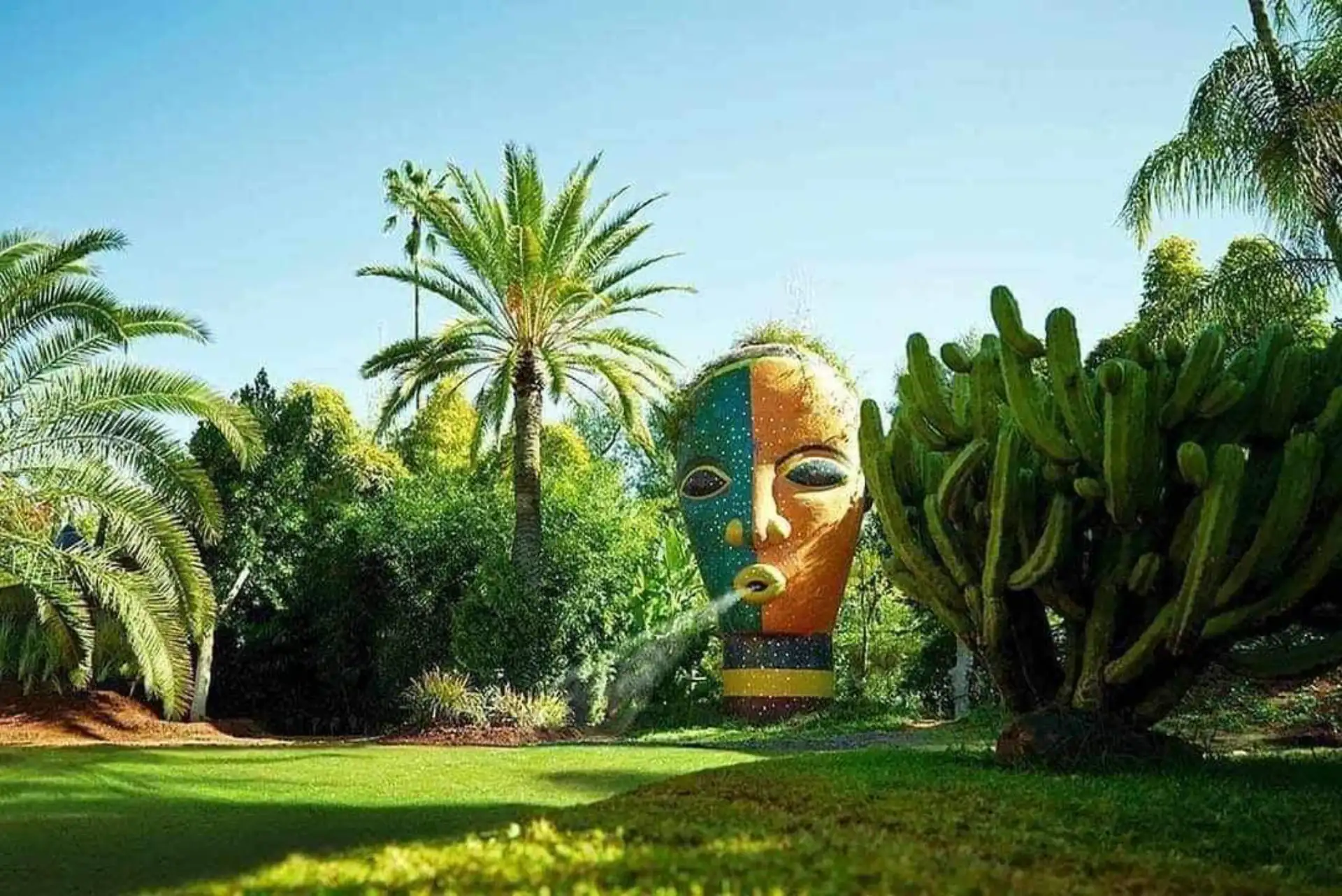
Anima is 15 kilometres north of Marrakech on the road to Aït Ourir — a 2-hectare botanical garden created by Austrian artist André Heller and opened in 2016. The concept is part garden, part outdoor art installation — sculptures and art objects are distributed throughout the plantings, and the design prioritises sensory experience over botanical taxonomy.
From the garden there is an unobstructed view of the High Atlas and, on clear days, Toubkal at 4,167 metres. The combination of tropical plantings, Atlas backdrop and art objects is unusual and works well. It is a genuinely pleasant half-day if you have already done the medina gardens and want something different.
Getting there requires a car or taxi — it is not accessible by foot or city bus. A petit taxi from the medina costs about 80 MAD each way.
Which Garden to Visit — Honestly
If you only have time for one: Le Jardin Secret for the medina context and the tower view, or Majorelle for the visual impact — go at opening time for either.
If you want to avoid crowds: Menara in the late afternoon. Free, peaceful, genuinely beautiful at sunset. Consistently undervisited.
If you have two full days in Marrakech: Majorelle in the morning of Day 1, Le Jardin Secret in the afternoon. Menara sunset on Day 2. Agdal if it happens to be Friday or Sunday.
If gardens are the reason you came: All five over two days, plus the aromatic garden at the entrance to the Ourika Valley which is worth the 40-minute drive and is usually combined with the Ourika Valley day trip.
Practical Information
Best time of year for gardens: March to May when everything is in flower. October and November for the olive harvest at the Menara and Agdal. Summer (July–August) is fine but hot — go early morning.
Photography: Majorelle does not permit tripods or professional camera equipment without prior authorisation. Le Jardin Secret and Menara have no restrictions.
Dress code: There is no strict dress code for any of these gardens, but modest dress (covered shoulders and knees) is appropriate for Le Jardin Secret which is adjacent to a functioning mosque.