Breakfast — The Two Versions
The Authentic Ftour
The real Marrakech breakfast — called ftour — happens early, in small neighbourhood spots where locals stop before work. The format is simple: a bowl of bissara (a thick soup of dried fava beans, olive oil, cumin and paprika), served with khobz bread, a hard-boiled egg or omelette, and a glass of sweet mint tea. The whole thing costs 15 to 20 MAD. Less than two euros.
Bissara is a working-class staple that has been eaten in Moroccan cities for centuries. It is also genuinely delicious — warm, filling, deeply flavoured from the cumin and the olive oil poured over the top. The best way to find a good bissara spot is to walk through the medina streets before 9am and follow the steam from the cooking pots. The places with the most Moroccans sitting on low stools outside are the right ones.
If you do this once during your Marrakech visit — get up early, find a ftour spot, sit among the locals, eat bissara with your hands and a piece of bread — it will be one of the things you remember most clearly about the trip.
The Modern Breakfast
The café terraces of Guéliz offer a completely different breakfast experience — freshly baked msemen (layered flatbread with honey and argan oil), beghrir (semolina pancakes with small holes that soak up the butter), brioches, croissants, eggs prepared multiple ways, fresh orange juice (12 to 15 MAD), coffee (20 to 25 MAD). The menus are posted at the door and the combinations are varied.
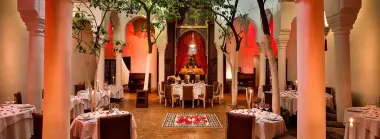
Some riads also serve breakfast to non-guests — worth asking at the door, particularly in the medina where a riad courtyard breakfast is a pleasant alternative to a café. The better riads serve local pastries, fresh fruit and Moroccan breads alongside the more standard options.
Harira — The Soup That Defines Moroccan Cooking
Harira is everywhere in Marrakech — a thick tomato, lentil and chickpea soup flavoured with coriander, celery, ginger and a squeeze of lemon. It appears on almost every menu in the city, from street stalls to mid-range restaurants, and the quality varies enormously.
The reference version is the harira of Ramadan — made with slow-simmered tomatoes, properly toasted spices and real lamb stock. Eaten at sunset to break the fast, with a date, a chebakia (fried sesame pastry with honey) and a hard-boiled egg. If you visit during Ramadan, eating harira at iftar time in the medina is one of the more memorable food experiences Morocco offers.
Outside Ramadan, harira ranges from excellent to watery. Our honest recommendation for reliable quality: Fusion Beldi in the medina, where the harira is made with real ingredients by a chef who has cooked in palace hotels. Some riads also serve excellent harira — worth asking when you check in.
Tagine — What It Actually Is
A tagine is not a dish — it is a cooking vessel. The conical clay pot traps steam and returns it as condensation, creating a slow-cooked braise with very little liquid. The result is meat or vegetables cooked in their own juices, concentrated and tender in a way that a regular pot cannot replicate.
The most common combinations: chicken with preserved lemon and olives, lamb with prunes and almonds (the sweet-savoury combination that characterises Moroccan cooking), kefta (spiced meatballs) with eggs and tomato, vegetarian with seven vegetables. All are served in the clay pot with khobz bread for dipping.
A tagine in a mid-range medina restaurant costs 100 to 150 MAD. The tourist restaurants around the main square charge the same prices for a significantly lower quality version. The difference between a tagine cooked slowly for three hours and one assembled quickly for tourists is immediately apparent.
Tanjiya — The Dish of Marrakech
Tanjiya is to Marrakech what bouillabaisse is to Marseille — a dish that exists almost nowhere else and defines the city's food culture. Lamb or beef, marinated overnight in preserved lemon, cumin, saffron, garlic and smen (aged salted butter), packed into a terracotta amphora and slow-cooked for 4 to 6 hours in the hot ashes of the hammam furnace. The cook takes the jarre to the hammam in the morning and collects it at lunchtime.
The result is meat that has essentially dissolved into a concentrated, deeply spiced sauce. Eaten with bread, no cutlery required. It is a dish that is not pretty — no garnish, no presentation — but the flavour is extraordinary.
Where to eat it: Chez Bejgueni, near the medina. Traditional setting, prices that reflect a local restaurant rather than a tourist destination, and a tanjiya that justifies its reputation. Go for lunch — it sells out.
Bastilla — The Dish That Surprises Everyone
Bastilla (or pastilla) is the dish that most surprises first-time visitors to Morocco — a savoury-sweet pie made with warqa pastry (similar to filo but made by hand, thinner and more delicate), filled with slow-cooked pigeon or chicken, almonds, egg and cinnamon, dusted with icing sugar and cinnamon on top. Sweet, savoury, crunchy, soft — all at once.
It is a dish with Andalusian origins, brought to Morocco by the Moorish refugees expelled from Spain in 1492. The sweet-savoury combination was standard in medieval Iberian cooking and survived in Morocco long after it disappeared from Spain.
The chicken version (bastilla au poulet) is more common and more accessible for first-timers. The pigeon version is the traditional one — slightly stronger flavour, worth trying if you want the authentic experience. A seafood bastilla (fruits de mer) also appears on modern menus and is excellent. Fusion Beldi serves all three versions, all well made. Price: 135 to 155 MAD.
Mechoui — Whole Roasted Lamb
Mechoui is a whole lamb or shoulder rubbed with butter, cumin and salt and slow-roasted in a clay oven for several hours until the meat falls from the bone. Ordered by weight (typically by the 100g), served with small dishes of cumin and coarse salt for dipping. No sauce, no accompaniment beyond bread.
It is a communal dish — traditionally served at celebrations and family gatherings — and the version in restaurants is a simplified but still excellent interpretation. Chez Lamine, near Chez Bejgueni in the medina, is the most consistent mechoui address in Marrakech. Local institution, no tourist menu, prices that reflect what Moroccans pay. Budget 80 to 120 MAD per person.
Couscous — And When to Order It
Couscous in Morocco is traditionally a Friday dish — the communal meal after the Friday prayer, served in a large shared bowl with seven vegetables and slow-cooked meat. It is made by hand, the semolina grains steamed multiple times over the stew until each grain is separate and light. The version made in 20 minutes in a pot of boiling water is a different product.
If you want the real version, eat couscous on a Friday at a restaurant that makes it properly. Seffa medfouna — couscous with vermicelli, raisins and cinnamon, served with chicken — is worth ordering if you see it on a menu. A less common dish and a beautiful one. Price at Fusion Beldi: 165 MAD.
Eating at Djemaa el-Fna — Honestly
The square is one of the most extraordinary places to spend an evening in Morocco. It is not, in our honest opinion, the best place to eat.
The Evening Street Food
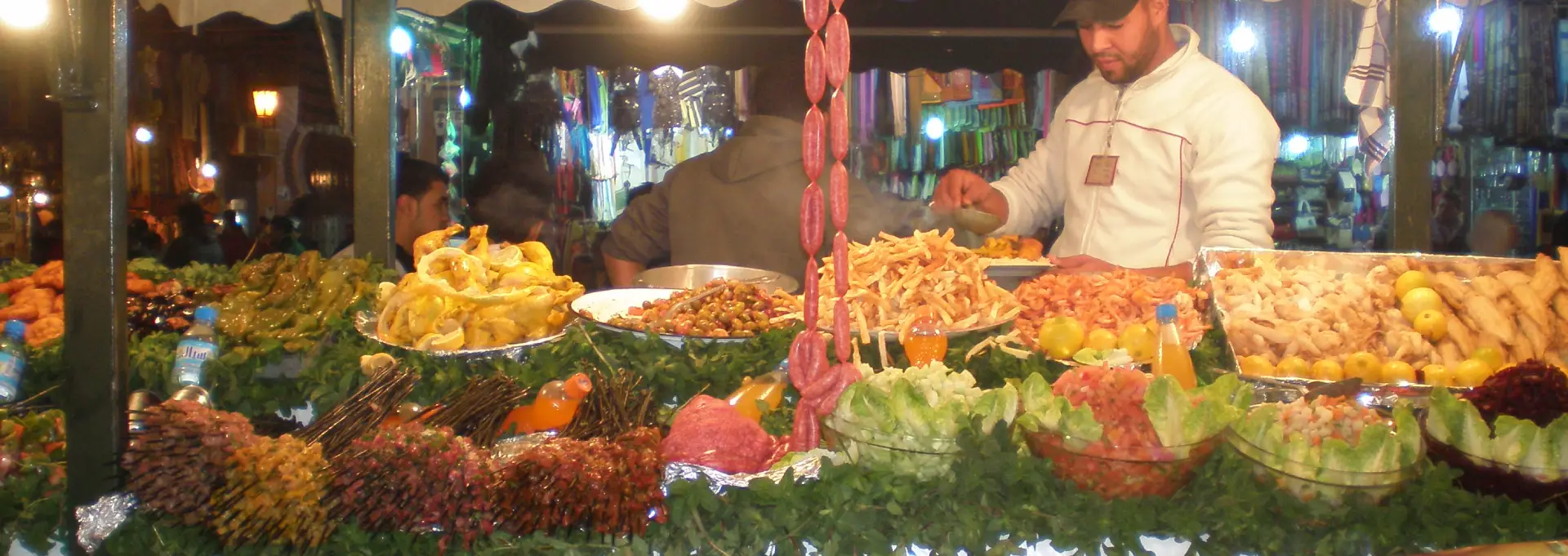
As darkness falls, the square fills with charcoal grills — brochettes, merguez, kefta, sandwiches, snail soup, sheep's head (if you are curious). Tourists love it. Locals largely avoid it. The quality is inconsistent and the prices are inflated by tourist demand.
If you are going to eat at the street stalls, stick to brochettes and kefta — the meat is fresh and grilled in front of you. Avoid the grilled fish and seafood stalls — the fish is often frozen and the turnover is not high enough to guarantee freshness. Budget 50 MAD for a decent street meal if you choose carefully.
One useful note: the vendors at the square have a remarkable ability to identify nationalities from a distance. Do not be surprised if you are greeted in your own language. Keep walking, smile, and do not engage — the harassment stops quickly once you are clearly in motion. It is theatre, not danger.
The Terrace Restaurants
The best way to experience Djemaa el-Fna at mealtime is from above, not inside the crowd. A coffee on a terrace (15 MAD) with an unobstructed view of the entire spectacle is one of the best value experiences in Marrakech. From there, open your maps app, find a restaurant nearby, and plan your actual dinner.
Groupe L'Adresse — the best restaurant on the square. Good food, genuinely excellent terrace view, prices to match. Arrive early and specifically ask for a terrace table — the wait is worth it. This is where to take someone you want to impress with a Djemaa el-Fna dinner.
Restaurant Argana — solid mid-range option on the square, main dishes around 150 MAD. Reliable.
Zeitoun Café — expect to spend at least 150 MAD per person for a meal with a view. Good quality, consistent service.
Addresses We Recommend
Fusion Beldi — Best All-Round Moroccan Restaurant
The most consistently excellent Moroccan restaurant we recommend to clients. The chef has cooked in palace hotels and it shows — the harira, bastilla, tagines and couscous are all prepared with real technique and quality ingredients. The presentation is modern without being pretentious. Mid-range prices for Marrakech (100 to 170 MAD for a main), but the quality justifies it. The address for anyone who wants to eat Moroccan food done properly.
Snack Al Bahri — Best Fish
The best fish in Marrakech at a price that makes sense. Fresh, simply cooked, at a quality level comparable to the port restaurants in Essaouira. The name means "of the sea" in Arabic and the restaurant lives up to it. No tourist menu, no upselling — just good fish at fair prices.
Chez Bejgueni — Best Tanjiya
The reference address for tanjiya in Marrakech. Traditional setting, local clientele, prices that reflect a neighbourhood restaurant rather than a tourist operation. Go for lunch — the tanjiya is ready around noon and sells out.
Chez Lamine — Best Mechoui
Next to Bejgueni, same neighbourhood, same ethos. The mechoui is what you order. Slow-roasted lamb, cumin, salt, bread. Nothing else needed.
Restaurant Ouazzani — For Spice Lovers
If you want Moroccan food with real heat — spices not toned down for international palates — Ouazzani is the address. The kind of place where the food tastes the way Marrakchis eat it at home. Not a tourist restaurant. Recommended specifically for anyone who finds Moroccan food elsewhere too mild.
Little Mama (Guéliz) — Budget Option
The go-to for affordable eating in the new city. Good food, honest prices, consistently full of local residents. If you are spending a day in Guéliz and want lunch without medina pricing, this is the address.
Price Guide — What to Expect
Street food / ftour spots: 15 to 50 MAD per person. Bissara breakfast 15-20 MAD. Street brochettes 30-50 MAD.
Local neighbourhood restaurants (Chez Bejgueni, Chez Lamine, Al Bahri): 60 to 120 MAD per person for a full meal.
Mid-range medina restaurants (Fusion Beldi): 150 to 250 MAD per person with a starter and main.
Terrace restaurants on Djemaa el-Fna (L'Adresse, Argana, Zeitoun): 150 to 300 MAD per person.
Drinks: Mint tea 15-20 MAD (do not bargain for this). Fresh orange juice 12-15 MAD. Coffee 20-25 MAD in a café. Coffee on a Djemaa el-Fna terrace: 15 MAD.
One general rule that applies everywhere: if the menu is displayed in six languages and a man is standing outside trying to pull you in, the restaurant has optimised for tourist revenue rather than food quality. Walk past and find the place that does not need to advertise on the pavement.