Erg Chebbi — The Dunes
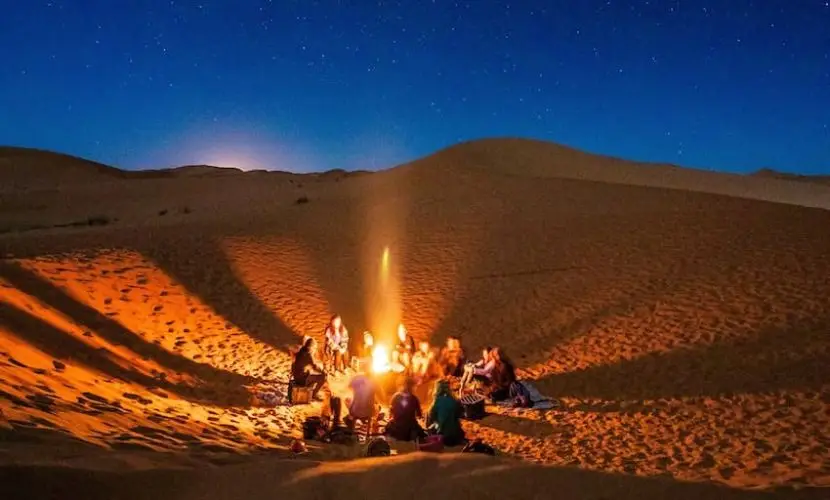
Erg Chebbi is an isolated sand sea — approximately 28 kilometres long north to south and up to 7 kilometres wide, reaching 150 metres at the highest dunes near the village of Hassilabied to the north. It sits on the Algerian border, separated from the main Saharan ergs by hundreds of kilometres of rocky hammada. That isolation is what makes the light here unusual — the dunes rise suddenly from a flat plain with no transition, orange against a sky with no haze.
The colour changes by the hour. Deep orange at sunrise, pale gold by midday, deep red at sunset, then black — genuinely black, with no ambient light — after dark. The wind reshapes the crests overnight, so the dunes you photograph in the evening have slightly different ridgelines by morning.
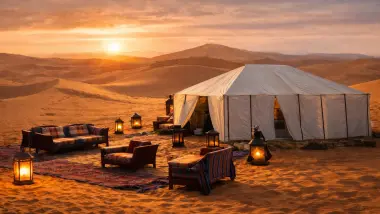
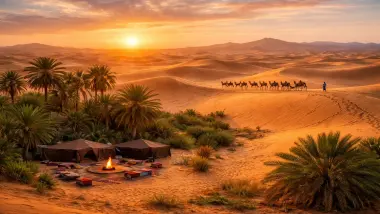
Most visitors arrive in the late afternoon, ride camels to camp at sunset, sleep in the dunes, and return to the village after sunrise. This is the standard experience and it works — the sunrise and sunset are the best moments and the overnight gives you both. One night is enough to understand why people come here. Two nights gives you a full day in the dunes to explore at your own pace.
Activities in and Around Merzouga
Camel Trek
The classic — and still the best way to enter the dunes. The pace of a camel means the light changes as you travel, and the perspective from the saddle above the sand surface is different from anything you get on foot. A one-hour trek to a camp at sunset is the standard format. Longer treks — half-day or full-day — are available for those who want to go deeper into the erg.
Quad Biking and Buggy
Quad bikes and dune buggies are available from operators in Merzouga village — most travelers arrive via our 3-day tour from Marrakech for sessions of 1 to 3 hours. The quad circuit typically takes you around the base of the dunes and through the hammada, with sections on the sand itself. The buggy is faster and more physical — good for adrenaline, less good for photography. Both available year-round, prices vary by season.
Sandboarding
Boards are available at most camps and from operators in the village. The technique is straightforward — lie flat, point downhill, hold on. The dunes at Erg Chebbi are steep enough to generate real speed on the longer runs. Less elegant than snowboarding but considerably warmer.
4x4 Desert Circuit
A full-day 4x4 circuit — included in our 4-day Merzouga tour — covers the hammada around Merzouga, the nomad settlements to the south, the Algerian border dunes, and the fossil beds near Erfoud on the return. Considerably more varied than the standard camel-and-camp experience — the rocky desert landscapes around the erg are as dramatic in their own way as the sand itself. Recommended for anyone spending two or more days in the area.
Visiting Nomad Families
Nomadic Berber families still live in the desert around Merzouga — moving with their animals through the seasons, living in traditional tents. Some welcome visitors for tea and a glimpse of desert life that has little to do with tourism. The quality of this experience depends entirely on the guide and the contact — arranged through your tour operator rather than independently.
Sunrise Dune Climb
Every camp offers this — a 5am wake-up and a 20-minute climb to the nearest high dune before dawn. The light sequence at sunrise over Erg Chebbi is one of the more reliable spectacular experiences in Morocco. Worth the early alarm regardless of how cold the night was.
Khamlia — The Gnaoua Village
Ten kilometres south of Merzouga, Khamlia is a small village whose inhabitants are descended from sub-Saharan African slaves brought north along the trans-Saharan trade routes centuries ago. Their musical tradition — Gnaoua — uses sintir bass lutes, krakeb metal castanets and specific rhythmic patterns originally used in healing ceremonies. The music is hypnotic and unlike anything else in Morocco.
The village has several musical groups who perform for visitors. Honest assessment: Khamlia has become significantly more touristy over the past decade and the performances are increasingly geared towards the day-trip audience. The music itself remains genuinely good — a 30-minute session with one of the established groups is worthwhile even if the setting is now partly staged.
The best Gnaoua experience in Morocco remains the annual Gnaoua Festival in Essaouira every June, where musicians from across West Africa and the diaspora perform over several days. Khamlia is an accessible introduction to the tradition; Essaouira is where to hear it properly.
Dayet Srij — The Flamingo Lake
Three kilometres from Merzouga, Dayet Srij is a seasonal salt lake that fills with water after winter rains. In good years — typically January to April — the lake attracts large numbers of flamingos on their migration route, along with dozens of other bird species: herons, egrets, waders and raptors.
The flamingos are the draw. Several hundred birds on a pink-tinged lake with the Erg Chebbi dunes as a backdrop is a genuinely arresting sight — and one that very few visitors know exists. The lake is a 10-minute drive or 40-minute walk from Merzouga village.
The lake does not fill every year — it depends on winter rainfall in the Atlas and the pre-Saharan region. Dry years (common) produce a flat salt crust rather than standing water. If you are visiting between January and April, ask locally whether the lake has filled that season before making the trip.
Best time: February and March in a good rainfall year. Early morning for the birds before the heat of the day. Binoculars useful but not essential — the flamingos are visible from the bank.
Choosing a Desert Camp
The range of camps at Erg Chebbi runs from basic Berber tents with shared washing facilities to luxury ensuite tents with heated pools and butler service. The price gap between the two ends is significant — a standard camp costs a fraction of a luxury property.
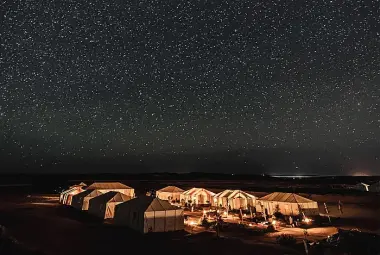
What matters more than the camp category is the location. The best camps are positioned behind the first dune ridge — out of sight of the village and the road, with nothing visible but sand in every direction. A mediocre camp in a good position beats a well-equipped camp that looks out over other tents and the village lights.
The other variable is the size. A camp of 8 to 12 tents gives a more authentic atmosphere than a large operation of 50 tents — the fire, the music and the stargazing are better when the group is small. Larger camps feel more like outdoor hotels.
Prices increase significantly in summer (July–August) when demand from domestic Moroccan tourism peaks. Booking through your tour operator typically gives access to partner camps at better rates than booking directly, particularly in high season. We work with selected camps at Erg Chebbi — ask us when booking your desert tour.
Best Time to Visit Merzouga
October to November — Ideal
The best overall window. Daytime temperatures in the dunes reach 25 to 28°C — warm enough to be comfortable but not exhausting. Nights are cool (10 to 15°C), making the camp fire and the stargazing genuinely pleasant. Tourist numbers are lower than spring. The light is excellent.
March to April — Best for Dayet Srij
Spring is the other strong window. The dunes can still be visited comfortably and Dayet Srij may have water and flamingos if winter rains have been good. Tourist numbers start rising in April as European school holidays approach.
December to February — Cold but Spectacular
Nights drop to 0 to 5°C and the standard camp tents are not heated. The cold is real — pack accordingly. The upside: the clearest skies of the year, the fewest tourists, and a quality of light and silence in the dunes that the warmer seasons cannot match. For serious photography or a truly isolated experience, winter is the best season.
July to August — Avoid if Possible
Daytime temperatures in the dunes reach 45 to 50°C. Walking on the sand in midday heat is physically dangerous. The experience is limited to early morning and evening windows. Prices are at their highest due to domestic tourism demand. If July or August is your only option, plan all dune activities before 8am and after 6pm.
Getting to Merzouga from Marrakech
Merzouga is 560 kilometres from Marrakech — approximately 9 hours by road via the most direct route over the High Atlas and through Ouarzazate and Erfoud. There is no practical public transport option for most travelers.
The standard approach is a guided desert tour with a driver who handles the navigation and stops. The drive itself — crossing the Atlas via Tizi n'Tichka, passing Ait Benhaddou, driving through the Draa Valley and the Tafilalt palm groves — is part of the experience. A 3-day tour from Marrakech gives you the drive south on Day 1, a night in the dunes on Day 2, and the return on Day 3.
We run daily shared and private desert tours from Marrakech to Merzouga. The 3-day tour is the most popular — enough time to do the journey properly.
See the 3-day Merzouga tour →Practical Information
Language: Tamazight (Berber) is the first language of most people in the Merzouga area. Arabic is widely understood. French works in most tourist contexts. English is spoken at camps and tour-related businesses.
Money: Cash only in Merzouga village and at most camps. The nearest ATM is in Rissani (20km) or Erfoud (55km). Bring sufficient MAD from Marrakech or Ouarzazate before heading into the desert.
Connectivity: Mobile signal (Maroc Telecom and Orange) is available in Merzouga village and the dune edges. Inside the dunes, signal disappears. Most camps have no wifi. This is not a problem — it is a feature.
What to bring to the dunes: A headscarf or buff against sand and wind, sunscreen factor 50+, sunglasses with UV protection, a warm layer for the night, comfortable shoes (sand gets inside everything — flip flops work for the camp, closed shoes for longer walks). Leave valuables at the camp.
Photography: The sand is very fine and gets into camera equipment. A zip-lock bag for your camera when not shooting is not excessive caution. The best light is the 30 minutes after sunrise and the 30 minutes before sunset — everything else is technically manageable but these windows are extraordinary.