What is Tinmel?
In the early 12th century, a Berber scholar named Ibn Toumert retreated to the remote Atlas village of Tinmal after being expelled from several Moroccan cities for his reformist preaching. From this mountain stronghold, he founded the Almohad movement — a religious and military force that would go on to conquer all of Morocco, Algeria, Tunisia, Libya and Muslim Spain within a few decades of his death.
The mosque at Tinmel was built in 1156 by Ibn Toumert's successor, Abd al-Mumin, to commemorate the founder and mark the birthplace of the dynasty. It is the model for every significant Almohad mosque that followed — including the Koutoubia in Marrakech, the Hassan Tower in Rabat, and the Giralda in Seville. The three great minarets of the medieval western Mediterranean world were all derived from this relatively modest mosque in an Atlas mountain village.
Tinmal was declared a UNESCO World Heritage Site in 1990. Restored in the 1990s after centuries of abandonment, it was severely damaged by the 2023 earthquake that struck the High Atlas region. Restoration work is ongoing — check current access conditions before visiting.
The Mosque Itself
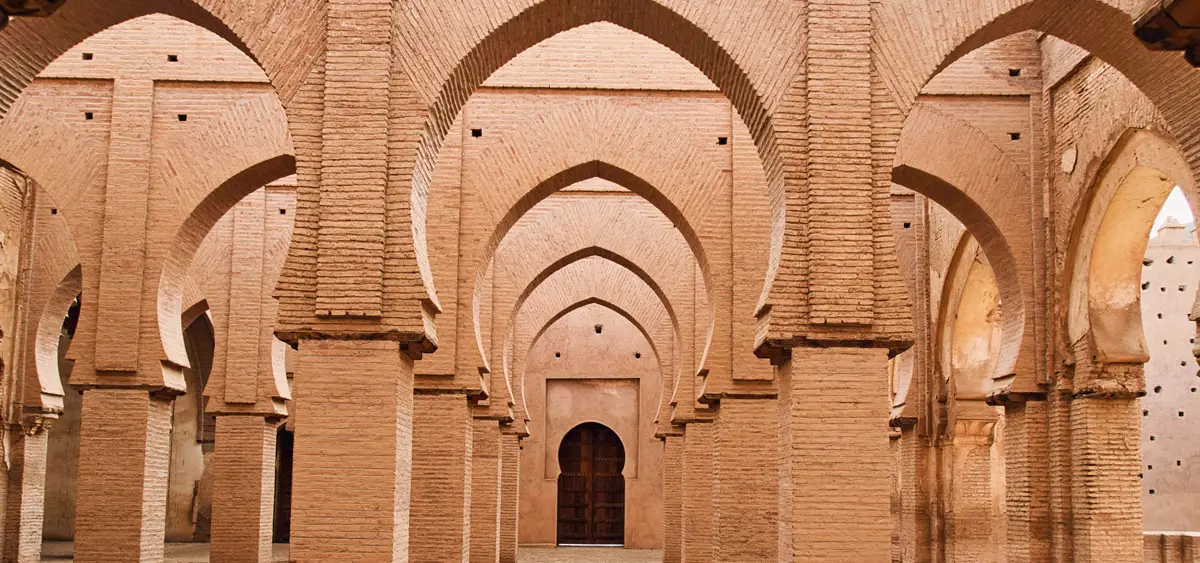
Tinmel Mosque is one of only two mosques in Morocco open to non-Muslims — the other being the Hassan II Mosque in Casablanca. This alone makes it exceptional. Most of Morocco's greatest religious architecture can only be admired from outside. At Tinmel, you can walk through the prayer hall, examine the columns and arches up close, and climb the minaret for the panoramic view of the surrounding valley.
The mosque follows the T-shaped Almohad plan — a wide central nave leading to the mihrab (prayer niche), crossed by a perpendicular aisle in front of the qibla wall. The proportions are austere by Moroccan standards — no zellige tilework, minimal decoration — which is characteristic of Almohad religious architecture, which rejected the ornate Almoravid style that preceded it.
What makes it remarkable is the context. Standing in the prayer hall, surrounded by horseshoe arches and the sound of the mountain river outside, it is easy to understand why this isolated place produced a dynasty that changed the history of three continents.
The Connection to Marrakech and Seville
When the Almohads captured Marrakech in 1147, they built the Koutoubia Mosque as the centerpiece of their new capital — using the Tinmel mosque as the architectural template. The Koutoubia minaret, visible from almost everywhere in modern Marrakech, is essentially a larger, more refined version of the Tinmel minaret.
The same template was used for the Hassan Tower in Rabat (1195) and the Giralda in Seville (1198) — the bell tower of Seville Cathedral, which was originally the minaret of the Great Mosque of Seville built by the Almohad caliph Yaqub al-Mansur. The Giralda is now one of the most recognizable buildings in Spain. Its origin is this Atlas mountain village.
The Goundafa Kasbah
A few kilometres from Tinmel, on the banks of the Nfis river, stands the Kasbah Talaat n'Yacoub — the fortress of the Goundafa clan — the southern route continues toward Ouarzazate on our 2-day Ouarzazate tour — the most powerful Berber feudal family of the western High Atlas for several centuries.
The kasbah is in partial ruin — walls collapsed, towers open to the sky, storks nesting on the remaining ramparts. But the decorated interior rooms that once housed the feudal chief are partially intact, with traces of Hispano-Moorish plasterwork and painted ceilings that have no business surviving in a building left to the elements for decades.
The Goundafa were finally broken by the French protectorate in the early 20th century. The kasbah has been abandoned since. There is something genuinely eerie about walking through a fortified palace that was recently inhabited but is now completely silent — storks above, the river below, and the plasterwork slowly dissolving back into the mountain.
Ouirgane Valley
The road from Marrakech to Tinmel follows the Ouirgane Valley — worth combining with an Ait Benhaddou day trip — a green, wooded river valley about 60 kilometres south of the city that serves as a transition between the Marrakech plain and the high Atlas. The drive itself is part of the experience, rising steadily through argan forest and Berber villages before the valley narrows and the mountains close in.
Ouirgane village is a stopping point in both directions — a collection of small restaurants and guesthouses known locally for grilled trout from the Nfis river. Lunch here on the return from Tinmel is one of those simple meals — fish, bread, mint tea, the sound of the river — that travel writers try to describe and mostly fail at.
The valley is also a starting point for hikes into the surrounding mountains, particularly towards the Kik plateau and the Amizmiz area. If you have a full day, combining Tinmel with a valley walk and lunch in Ouirgane makes for a genuinely satisfying day out of Marrakech.
Practical Information
Distance from Marrakech: approximately 90 kilometres, 1.5 to 2 hours by road depending on the route taken.
Access: The road to Tinmel branches off the Tizi n'Test road (route 203) south of Ouirgane. The last section is a narrow mountain road. A regular car handles it fine but driving requires attention. The route passes through several Berber villages with no services.
Current conditions (2024): The September 2023 earthquake caused significant damage to buildings in the High Atlas region, including Tinmel Mosque. Restoration is ongoing. Verify current access conditions before your visit — the site may have restricted access to certain areas.
What to bring: Modest dress for entering the mosque (shoulders and knees covered). Comfortable walking shoes for the uneven terrain around the kasbah. A layer — the valley sits at over 1,000 metres and the temperature is noticeably cooler than Marrakech.
Best combined with: The Tizi n'Test pass continues south of Tinmel to Taroudant — one of the most dramatic mountain roads in Morocco. A full day with a private car can cover Tinmel, the Goundafa Kasbah, the Tizi n'Test summit at 2,093 metres, and Ouirgane lunch on the return.