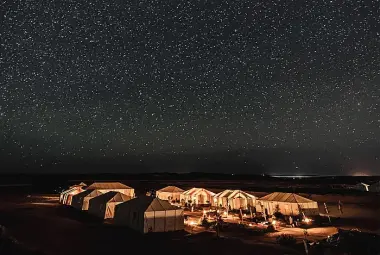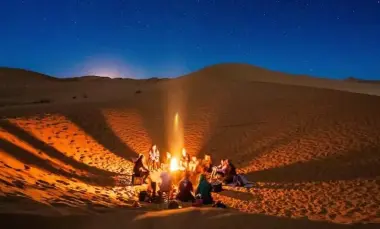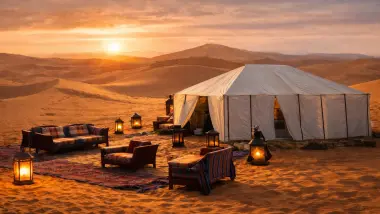
What the Experience Actually Feels Like
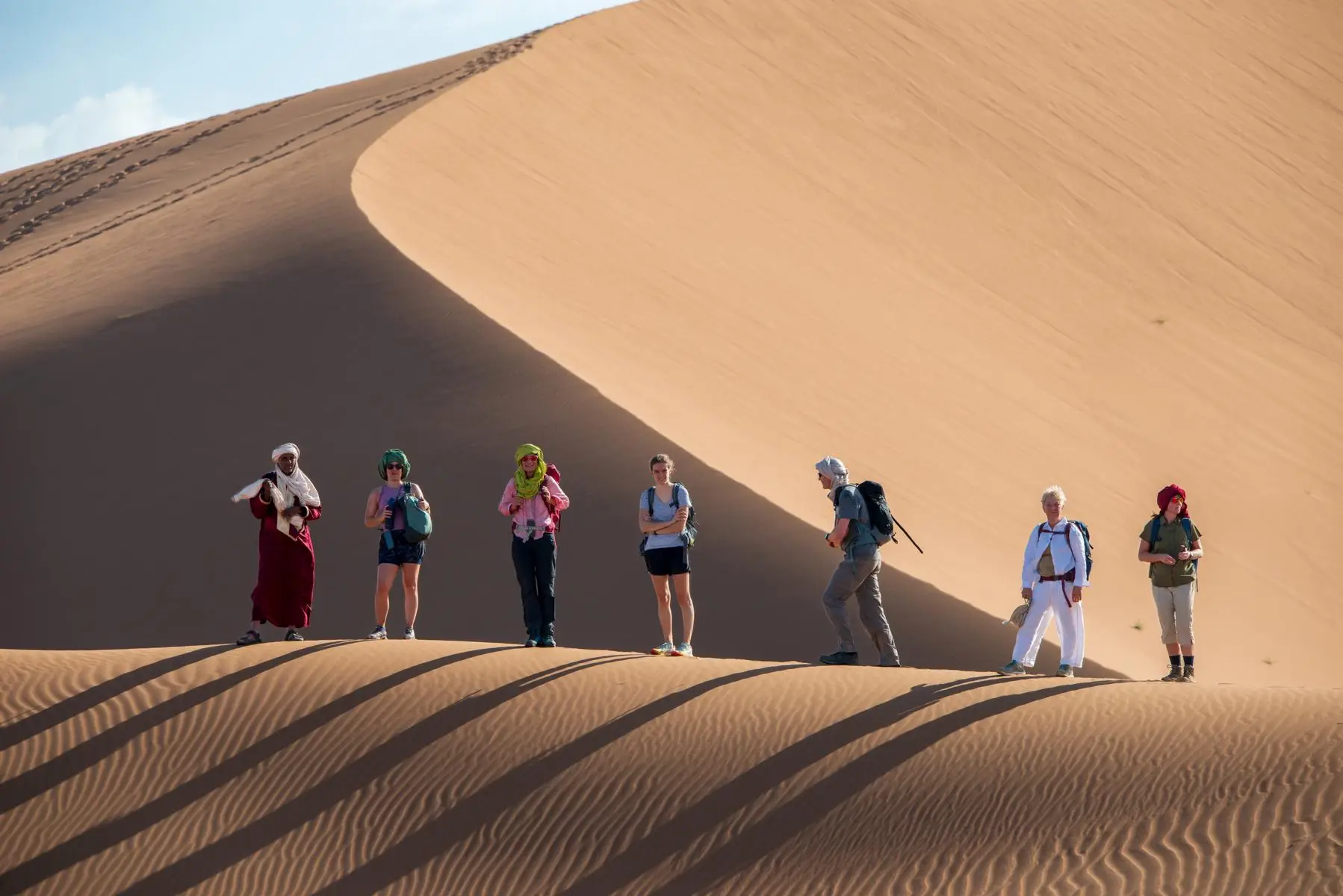
The standard camel trek at Erg Chebbi takes about an hour each way — from the edge of the village to the camp, in the late afternoon as the sun drops. In practice, by the time you have been fitted with a turban, been introduced to your dromedary, watched it stand up (they go back legs first, which pitches you forward sharply — hold on), and settled into a rhythm, the experience is closer to 90 minutes from start to camp arrival.
The motion is a slow, deliberate rocking — side to side with each step, the sand shifting below you, the dunes rising on either side. The pace means the light changes as you travel. A dune that was orange when you set off is deep red by the time you crest it. That progression — the slow movement through a landscape that is actively transforming in the last hour of daylight — is what makes the camel the right way to arrive at the desert camp.
The animals are calm and guided by a handler who walks alongside. You do not need to know how to ride. You do not steer. You sit, hold the pommel if you feel unsteady, and look at what is around you.
The Honest Truth About Comfort
We will say it directly: a dromedary is not a comfortable animal to ride. The saddle is a wooden frame covered with blankets and rugs. After 45 minutes, most people who do not ride regularly start to feel it in their hips and lower back. After an hour, some people are genuinely ready to get off.
This is worth knowing in advance — not to put you off, but so you are not surprised. The solution is simple: if you feel uncomfortable, tell your guide. He can slow the pace, suggest a break, or arrange the 4x4 transfer instead. No one will judge you and no one will miss the experience of the camp, the stars and the sunrise by taking a different route there.
The other side of this: plenty of people get on a dromedary for the first time and genuinely do not want to get off. Something about the height, the motion and the landscape makes it work for them in a way that is hard to predict in advance. We have had clients who extended their trek well beyond the standard duration just because they were enjoying it.
The honest advice: do not decide in advance that you will or will not enjoy it. Get on, give it 20 minutes, and let the dunes make the case for themselves.
Camel Trekking at Merzouga — Erg Chebbi
Merzouga is the reference destination for camel trekking in Morocco — the sunset trek is included in our 3-day Merzouga tour. The dunes of Erg Chebbi — 22 kilometres long, 150 metres at the highest point — provide the backdrop that most people picture when they imagine Morocco. The trek from the village edge to a camp behind the first dune ridge takes about an hour at a walking pace.
The timing is built around sunset. Departure is typically around 4pm to 5pm depending on the season — early enough to be moving through the dunes as the light changes, arriving at camp around dusk. The return trek the following morning leaves before dawn for the sunrise, reaching the village as the day heats up.
The dromedaries at Merzouga are working animals accustomed to this circuit. Most are placid and experienced. The handlers — local Berber guides from the surrounding desert communities — know the animals individually and manage any temperament issues before they become a problem for riders.
Zagora and M'Hamid — The Draa Valley
Zagora and M'Hamid offer a different desert experience from Merzouga — the Draa Valley desert is less dramatic in terms of dune height but more varied in landscape. Palm groves, ancient ksour (fortified villages), the dry Draa riverbed, and sand dunes that appear and disappear along the valley. The camel trek here tends to feel more like traveling through a landscape than climbing over one.
Our 2-day M'Hamid tour starts at the gateway to Erg Chegaga — a much larger and wilder sand sea than Erg Chebbi, with fewer visitors and a more genuinely remote atmosphere. A camel trek to an Erg Chegaga camp involves several hours in the saddle and is one of the more committed desert experiences available from Marrakech.
Zagora is closer to Marrakech (approximately 7 hours) and works well for a 2-day trip when time is limited — or combine both on our Zagora + Merzouga 4-day tour. The dunes at Zagora are smaller than Erg Chebbi but the camel and camp experience is essentially the same.
Agafay — For Those Without 9 Hours to Spare
Not everyone can justify the 9-hour drive to Merzouga. For those who want a camel experience without the multi-day commitment, the Agafay desert — 40 minutes south of Marrakech — offers camel rides on a rocky plateau with the High Atlas as a backdrop. It is not the Sahara. The dunes are not there. But the dromedaries are the same animals and the late afternoon light over the Agafay plain has its own quality.
Agafay works as an introduction to the experience — particularly for families with children who may not manage a full desert tour, or for travelers with a limited schedule who want at least one camel photo before they leave Morocco. A 30 to 45-minute ride at Agafay costs a fraction of the Merzouga equivalent and requires only a half-day from the city.
The Evening at Camp — What Happens After
The camel trek is the arrival. What follows is the part people tend to remember longest.
At Erg Chebbi, after the trek ends and bags are dropped in the tent, the evening unfolds at the pace of the desert. Dinner in the main tent — tagine, couscous, bread, mint tea. Then the fire outside, and the Gnaoua drums. The guides bring out sintir and krakeb and play the rhythmic patterns that come from centuries of trans-Saharan musical tradition. The music is quiet rather than loud, which suits the setting.
Some evenings the group stays around the fire for hours. Other evenings, people drift away early to lie on the dunes and look at the sky. Both are right. The desert does not have a schedule.
What the fire-and-music evenings at a good desert camp have in common — regardless of how many people are there — is a quality of stillness that is genuinely difficult to find elsewhere. No road noise. No city light. The sound of the wind over the dunes and the percussion of the drums. That combination is why people come back.
Practical Advice
What to wear: Long trousers rather than shorts — the saddle rubbing against bare skin accelerates the discomfort. Light layers for the trek (warm during the day, cold after sundown). Closed shoes rather than sandals — sand at this temperature at 4pm in summer is hot enough to be uncomfortable on bare feet.
The turban: Every guide will offer to wrap a turban before the trek. Accept it. Not just for the photo — the fabric genuinely keeps sand out of your face, your eyes and your ears on the ride.
The mount and dismount: Dromedaries rise and sit in a specific sequence — rear legs first when sitting, front legs first when rising. Both movements pitch you forward then back. Hold the pommel. It takes two or three attempts to anticipate the motion. After that, it becomes natural.
Children: Children generally take to dromedary riding more easily than adults. The motion does not bother them and the height is exciting rather than alarming. Most camps accommodate children on the same saddle as an adult for the youngest, or on smaller animals for children over 8 or so.
Cameras and phones: The camel motion makes sharp photography difficult. Burst mode on your phone camera gives you a better chance of a usable frame. The best photographs from a trek are taken during pauses when the animal is still, or from the ground looking up at riders against the dunes.
The 4x4 alternative: Always available. If you or anyone in your group has back, knee or hip issues, the 4x4 transfer to camp takes 10 minutes and misses nothing of what happens after arrival. The camel is the journey, not the destination.